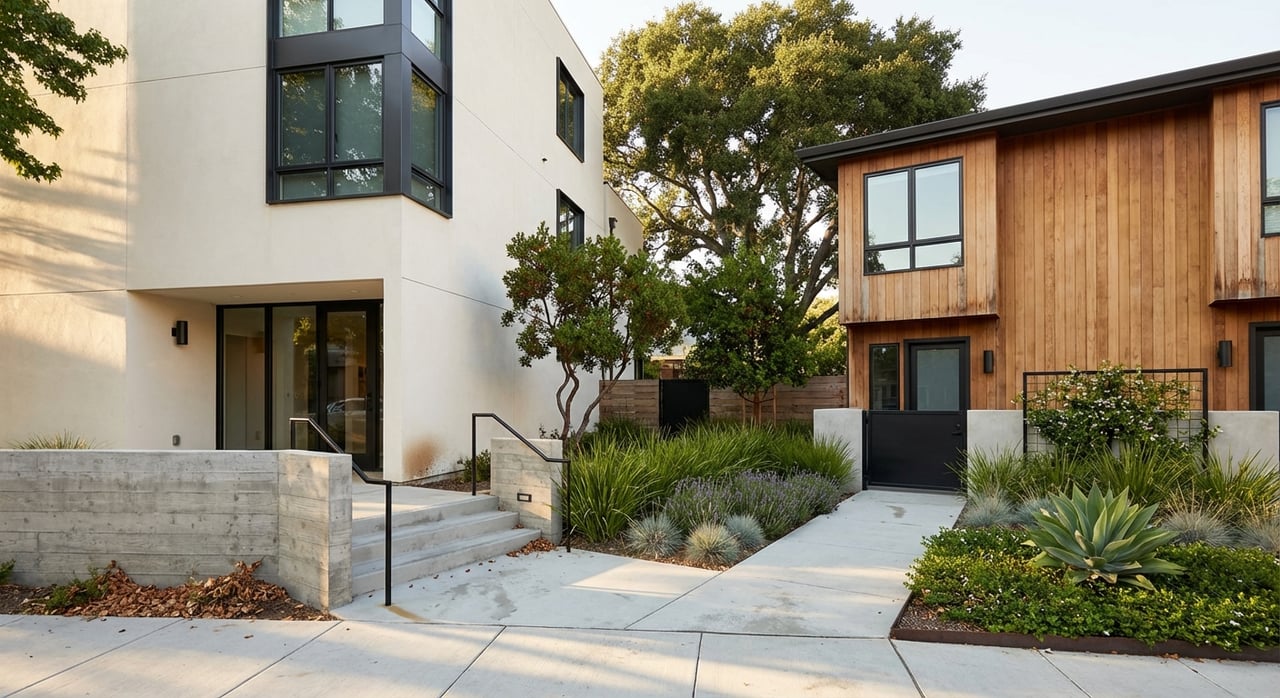
Torn between the convenience of a condo and the extra space of a townhome in Mountain View? You are not alone. With prices, HOAs, and commute tradeoffs to weigh, it helps to look at the decision through a local lens. In this guide, you will compare costs, ownership details, lifestyle fit, inspections, and due diligence steps so you can choose with confidence. Let’s dive in.
Mountain View market snapshot
As of Jan 2026, Redfin reports Mountain View’s median sale price at about $1.66M. Condo listings commonly show one-bedroom options in the $400k to $800k range, with many two-bedroom condos reaching and exceeding $900k. Townhomes often list between roughly $1.1M and $1.9M. These are market snapshots and change month to month, so confirm current numbers before you decide.
What you own: condo vs townhome
Condos in brief
With a condo, you typically own the interior of your unit plus a fractional interest in shared areas. The HOA often maintains the building exterior, roof, parking structure, landscaping, and shared amenities. California’s common-interest rules under the Davis–Stirling Act guide how HOAs operate and what they must disclose.
Townhomes in brief
A “townhome” can be fee-simple (you own the land and structure) or organized under a condo regime with shared exterior responsibilities. The recorded map and CC&Rs control who maintains the roof, siding, fences, and decks. Marketing labels can be misleading, so always verify the legal structure and maintenance chart in the documents. A clear consumer overview of these differences is summarized in this condo vs. townhouse guide.
Why CC&Rs matter
The CC&Rs tell you what you own and what the HOA controls, which drives your maintenance costs and future resale. Two similar-looking townhomes can have very different owner obligations. Read the recorded documents early to avoid surprises on exterior upkeep or insurance.
Financing factors to know
Lenders often treat condominium projects differently from fee-simple or PUD townhomes. Some loan programs require condo project approvals, minimum reserves, and specific insurance coverage. If you are eyeing a condo, ask your lender up front whether the project is approved for the loan you plan to use.
For townhomes that are fee-simple or PUD, project-level hurdles are often lighter. Either way, get your lender’s checklist early, since project status can affect both your rate and your ability to close on time.
Cost comparison: your total monthly
Buy with the full, realistic monthly in mind, not just the sticker price. Compare:
- Mortgage principal and interest
- Property taxes
- Homeowner’s insurance (plus any HOA master-policy gap you must cover)
- HOA dues (and what they include)
- A maintenance reserve for items you must repair or replace
Quick steps to run the numbers:
- Estimate your loan amount and rate, then plug into a mortgage calculator.
- Add property taxes based on the expected purchase price.
- Price your individual insurance policy and ask the HOA for the master-policy declarations.
- Add the HOA dues and note what they cover.
- Set a monthly maintenance reserve for items not covered by the HOA.
Purchase price ranges
- Condos: One-bed units frequently list around $400k to $800k, with many two-beds pushing to and above $900k.
- Townhomes: Often range from about $1.1M to $1.9M depending on size, age, and location.
HOA dues and coverage
Condos often include building insurance, exterior maintenance, elevators, pools, garages, and shared mechanical systems in the dues, which can raise the monthly amount. Townhome HOAs vary. Some cover only common areas and private roads. Others include roofs and exteriors, which generally increases dues. Do not judge by the headline fee alone. Ask for the budget, reserve study, and the last two to three years of financials to see whether dues are realistic.
Space, privacy, and lifestyle
Condos deliver low-maintenance living with smaller private outdoor spaces like balconies. You will likely have shared walls and floors, which can mean more neighbor proximity. If you prioritize walkability and transit access, a condo near Castro Street can be a smart fit.
Townhomes more often offer ground-level patios or small yards, private entrances, and attached garages. You still share party walls, so sound transfer depends on construction quality. If you want a house-like feel without the full upkeep of a single-family home, a townhome can balance space and convenience.
Appreciation and resale considerations
In many markets, townhomes that include land and private entries tend to track closer to single-family home trends. Condos often depend more on building condition, HOA governance, and the supply of similar units. In Mountain View, tight land supply and strong employer demand help townhomes with private garages and entries command a premium over many stacked condos. Long-term direction varies by neighborhood and building, so pair current sales data with project-level health.
Inspections and HOA watchouts
Condo focus areas
- Building envelope and water intrusion at balconies, windows, and roof penetrations
- Garage or parking structure condition and drainage
- Shared mechanicals like central HVAC, boilers, and elevators, including age and service history
- Reserve adequacy, recent special assessments, and any pending litigation
- Fire safety and seismic retrofit status for older multi-story buildings
These topics commonly appear in HOA disclosure packets required under California’s Davis–Stirling framework. Read them closely.
Townhome focus areas
- Clarity on who maintains the roof, siding, fences, and decks per CC&Rs
- Roof condition, gutters, and site drainage around small yards and patios
- Party-wall construction and sound transmission
- Termite and pest history, especially for older buildings
- Garage access and grading, including any water intrusion
Due diligence checklist
Request these early and review with your agent, lender, and inspector:
- HOA resale packet with CC&Rs, bylaws, rules, budget, reserve study, insurance declarations, meeting minutes, and special-assessment history, as outlined by Davis–Stirling
- Recorded map/plat confirming whether the property is a condo regime or fee-simple/PUD townhome; this condo vs. townhouse explainer clarifies why it matters
- Two to three years of HOA financials and minutes to spot deferred maintenance or underfunded reserves
- Master insurance details and owner deductibles; confirm what utilities are master-billed
- Any pending litigation or warranty issues for newer phases
- For condos: elevator, roof, and HVAC replacement plans and funding
- For townhomes: who pays for roof and exterior items
- Lender project approval if you plan to use FHA or VA financing
- Full home inspection, plus deck/balcony and pest inspections where indicated
Commute and location factors
The Downtown Mountain View Transit Center links Caltrain, VTA light rail, and buses right by Castro Street. Units within an easy walk to the hub often trade at a premium for commuters heading to San Jose or San Francisco. You can learn more about the hub at the Downtown Mountain View station page.
Mountain View also concentrates major employers. Google’s long-standing presence, along with firms like Intuit and NASA Ames, shapes demand in North Bayshore and the Shoreline corridor. For background on Google’s growth, see the history of Google. If a short commute or shuttle access is key, weigh that location premium when comparing a condo near transit to a townhome a little farther out.
Which is right for you?
- If you want low maintenance near downtown and transit: A condo close to the Transit Center can minimize car use and simplify upkeep. Confirm HOA health, pet policies, and any rental rules before you commit.
- If you want a house-like feel with a garage and outdoor space: A townhome may cost more up front but gives you private entries, attached parking, and a small yard or patio. Inspect the roof and drainage carefully.
- If you are optimizing for entry price or down payment: Condos often provide the lower price point. Review rental restrictions, reserves, and project financials to protect future liquidity.
How we can help
Choosing between a condo and a townhome is about more than price. It is about ownership structure, HOA risk, maintenance exposure, and lifestyle. Our team pairs local market knowledge with technical insight to help you read CC&Rs, stress-test HOA budgets and reserve studies, and zero in on the right inspection focus. When you are ready to compare real units and run precise monthly cost scenarios, connect with the Moussavian Real Estate Team for tailored, data-forward guidance.
FAQs
What is the main difference between a Mountain View condo and a townhome?
- A condo typically conveys the interior plus shared common areas under an HOA, while a townhome may be fee-simple or part of a condo regime; the CC&Rs define who maintains roofs, exteriors, and grounds.
How do HOA dues differ for Mountain View condos versus townhomes?
- Condo dues often cover building insurance, exterior maintenance, and amenities, which can increase monthly costs; townhome dues vary, from minimal common-area coverage to full exterior maintenance.
What inspections are most important when buying a Mountain View condo?
- Focus on building envelope and water intrusion, parking structure drainage, shared mechanical systems, reserves and assessments, and any fire or seismic retrofit requirements.
What inspections should I prioritize for a Mountain View townhome?
- Verify who maintains exteriors, then inspect roof, gutters, drainage, party-wall construction, termite history, and garage access or water intrusion risks.
How can commute needs influence a condo vs townhome choice in Mountain View?
- If you rely on Caltrain or VTA, a condo near the Downtown Transit Center may be worth the tradeoff in space; if you value a garage and patio, a townhome farther from transit might fit better.